Leadership Profiles
Socially Responsible Investing
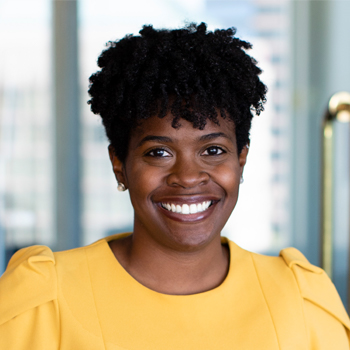
Ebony Perkins, Investor and Community Relations Manager
Ebony Perkins is a dedicated, solution-oriented social entrepreneur whose heartbeat is community. She has a demonstrated ability of working with investors and philanthropists to help them make smart and strategic decisions. As Self-Help's Investor & Community Relations Manager, Ebony helps groups and individuals invest funds in a socially responsible financial institution that supports communities of all kinds, especially those underserved by conventional lenders. Before that role, she served as the Donor Relations Manager at Central Carolina Community Foundation where she managed a system to engage and educate over 400 individuals and groups to help them achieve their charitable goals.
Ebony’s commitment to community investing is evident by her service and contributions to Women In Philanthropy, Durham Center for Senior Life, and the University of North Carolina MPA Alumni Board. Ebony was also recognized on the SRI Conference's inaugural 30 Under 30 List.
Ebony holds a Master of Public Administration from the University of North Carolina at Chapel Hill and a Bachelor of Science in Marketing from Claflin University as a summa cum laude graduate. She also has an Executive Certificate in Financial Planning from Duke University.

Nuray Ozbay, Policy and Impact Investment Associate
Nuray Ozbay leads Self Help’s efforts to cultivate mission-supportive depositors and impact investors within and beyond Self-Help’s California footprint. As a global movement and relationship builder, Nuray loves working with change-makers across non-profit, corporate, and public sectors. Her expertise is in intersectional gender equality, global civil society activism, social justice, and ESG investing. Nuray currently serves as a Board Director at the UN Women San Francisco Chapter and a National Expert on Violence Against Women at the European Women’s Lobby, the largest umbrella organization of women’s associations across Europe. Before joining Self-Help, Nuray spent 11 years in the social impact sector as a researcher, consultant, and non-profit leader across Turkey and Europe, working on issues including but not limited to immigration, women’s access to economy, financial literacy & inclusion, entrepreneurship, and care economy.
Kimberly Jones, Investment Associate
Kimberly's professional career spans both the nonprofit and community development financial services sectors, with expansive senior leadership roles in arts management; business and resource development; community relations; and corporate philanthropy. Currently, she's Self-Help's Investor Relations Manager, where she helps individuals and institutions align their banking and investments with their mission, vision, and values. Kimberly has held leadership positions that advanced the missions of creative organizations and community development financial institutions seeking to make a difference in communities in their footprint. She has been a founding board member of mission driven organizations that supported the growth and development of young artists, creatives, and professionals in the nonprofit sector.
In 2015, Kimberly was selected to be a PLACES Fellow with The Funders Network, where she explored the role of philanthropy through an equity lens in low to moderate income communities. She has served as a grant/award reviewer for organizations that championed organizational excellence, community development, and environmental sustainability. Kimberly has a BA in Political Science from the University of Minnesota-Morris and an MA in Arts, Entertainment, and Media Management from Columbia College Chicago.
Green Economy; Sustainable Society; Investing for the Environment
Melissa Malkin-Weber, Sustainability Director
Melissa has worked across a broad span of hands-on sustainability practices. At Self-Help Credit Union, she integrates the triple bottom line into the organization’s financial products, operations, and buildings portfolio. She led Self-Help to realize over $1.7 million in net present value from initiatives in this sector, including $180,000 energy savings in our own operations. Melissa previously directed the residential energy efficiency and indoor air quality research program at Advanced Energy and worked in industrial pollution prevention at RTI International. She earned her law degree from University of Michigan, and her Master's from UNC’s School of Public Health.
Shondra Tanner, Mortgage Lending
Shondra Owens Tanner brings her extensive experience and commitment to making mortgage loans for low-wealth families to her position as Self-Help's Director of Mortgage Originations, where she oversees all North Carolina home loan origination and new business development. Shondra's areas of expertise includes buying your first home, mortgage basics (documentation, closing costs, down payments), delinquency and loss mitigation (What is a forbearance and loan modification and what does that do to your credit?)
Credit Building 101 for AANHPI Communities & Immigrants

We can’t close out May without taking time to honor Asian American, Native Hawaiian, and Pacific Islander (AANHPI) Heritage Month! The AANHPI community in the U.S. is made up of a huge range of people coming from over 50 different ethnic backgrounds.
In this blog post, we will be discussing what credit is, what goes into your credit, and steps that AANHPI communities and immigrants can take to build credit.
What is credit and how is it used?
Credit is the process of borrowing and repaying money, often with interest. Credit scores are numbers that lenders or landlords use to assess how much risk a potential borrower might be when applying for a loan, rental housing, credit card, and more.
Lenders and landlords are essentially trying to figure out how likely it is that you will pay back any money you borrow or owe.
There are three major credit bureaus – Experian, Equifax, and TransUnion – and all of them typically calculate something called a FICO® Score, or sometimes a VantageScore. These different types of scores have different guidelines for
how the score is formulated.
This video from FICO offers a quick explanation of what a FICO score is.
According to TomoCredit, even if you had great credit in another country, that credit history usually does not transfer to the U.S.,
which means you will likely have to build your credit history from scratch. FICO scores require six months of credit history before providing a credit score, while the lesser used VantageScore has no minimum history requirement, offering a credit
score as soon as an account is opened.
What goes into your credit score?
Five different factors make up your FICO credit score:
Payment history (35%) - Have you made payments on time? If not, what was the nature of your missed payments? Have you filed for bankruptcy?
Total debt (30%) - What is the total amount of money you currently owe (current loans, credit card balances, etc.)? How does this compare to your total credit limit?
Length of credit history (15%) - When was your first credit account, most recent, and what’s the average age of your credit accounts?
Recently sought new credit (10%) - Have you applied for credit in the last year?
Types of credit used (10%) - Have you had different types of credit accounts (cards, loans, etc.)?
For immigrants, you likely won’t have all or any of these factors accounted for in the U.S., and when you don’t have credit, ironically, it makes building credit challenging. However, there are options to get started building your credit
today.
Building your credit
Whether you have no credit or you’re looking to build credit, here are some ways Experian recommends getting started:
Get a Social Security number (SSN) or Individual Taxpayer Identification Number (ITIN)
Open a U.S. bank account
You can open a U.S. bank account as long as you have some form of identification. This can include your SSN or ITIN, U.S. state or local ID, consular ID, or passport.
Credit unions like Self-Help tend to focus on underserved populations and are more community oriented. Find a bank or credit union that supports your needs and offers services in your native language, if that is helpful.
Apply for a credit card
While some credit cards require an SSN, there are credit card issuers that will accept an ITIN.
Getting a credit card when you have no or low credit history can be difficult. Try finding a share-secured credit card to start off with. At Self-Help, our share-secured cards have a credit limit that is backed by cardholder funds held as collateral in a Self-Help CU account, and they offer the same benefits as our standard credit cards.
Become an authorized user on someone else’s card
If you don’t qualify for credit on your own, find out if you have a close family member, partner, or friend who can add you as an authorized user onto their account.
As an authorized user, you’ll benefit from the primary card holder’s credit history and on-time payments for the account.
Use a credit-building product, like a credit builder loan
Like share-secured cards, credit builder loans don’t require credit history to start building credit. With these products, you essentially borrow money from yourself.
Self-Help's credit builder loan works by putting the money you borrow into a savings account for
you. The account builds interest as you pay off the loan. Once the loan is paid off, the money in the account and any interest it has earned are yours to keep.
Building credit for the AANHPI community and immigrants is about creating a foundation for wealth and economic opportunity. It is the stepping stone that helps stabilize communities.
At Self-Help we honor the incredible contributions and history of Asian American, Native Hawaiian, and Pacific Islanders this AANHPI Heritage Month and beyond. We believe that everyone should have access to ownership and economic opportunity, and
we thank you for being part of our community.